Cybercriminals Leverage Fake Itineraries in Renewed Phishing Campaign Targeting Global Travel and Hospitality Sectors


As travelers worldwide continue to navigate a turbulent landscape marked by flight cancellations, lost baggage, and overbooked hotels, a new operational hazard has emerged to compound their frustrations. A sophisticated, financially motivated cybercrime collective known as TA558 has dramatically escalated its malicious activities, taking advantage of the post-pandemic resurgence in global tourism. By deploying highly targeted phishing emails disguised as routine hotel reservations, flight confirmations, and travel itineraries, the threat group is successfully compromising corporate networks and consumer devices alike, delivering a potent suite of remote access trojans and data-stealing malware.
Security researchers tracking the group note that TA558 has strategically pivoted its tactics to bypass modern security defenses. Following a temporary lull in operations corresponding to the height of COVID-19 travel restrictions, the collective has modernized its playbook. The group is no longer relying solely on the traditional macro-enabled Office documents that once defined its campaigns. Instead, cybercriminals are adapting to the evolving cybersecurity landscape by utilizing container file formats such as ISO and RAR archives, marking a significant evolution in their technical capabilities and posing severe risks to the international hospitality sector and its clientele.
Anatomy of an Attack: From Phishing Lure to Full Compromise
The modus operandi of TA558 centers heavily on social engineering, exploiting the fast-paced, high-volume operational environments characteristic of the travel and hospitality industries. Front-desk personnel, reservation managers, and travel coordinators frequently receive inquiries and booking documents from unknown parties as a standard part of daily business operations. This operational reality makes the sector an ideal target for phishing campaigns.
Typically, the attack begins with an innocuous-looking email written in Spanish, Portuguese, or English, often bearing a simple subject line such as reserva or referencing a specific hotel booking. Attached to these messages, or accessible via hyperlinked URLs embedded within the text, are compressed container files—specifically ISO and RAR formats.
According to threat intelligence reports released by cybersecurity firm Proofpoint, this reliance on container files represents a direct response to Microsoft’s late 2021 and early 2022 decisions to disable Visual Basic for Applications (VBA) and XL4 macros by default across its Office productivity suite. Because organizations increasingly block macro execution to prevent malware infections, threat actors like TA558 have been forced to innovate.
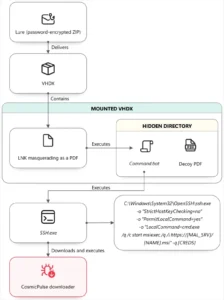
When a targeted victim interacts with the malicious email, they are typically tricked into downloading and extracting the container file. For instance, recent telemetry analyzed by researchers reveals that clicking a reservation link can lead to the download of an ISO file containing an embedded batch script. Upon execution, this batch file triggers a PowerShell helper script, which operates silently in the background to fetch and install a secondary payload. In many observed instances, the ultimate payload delivered is AsyncRAT, a powerful remote access trojan that grants the attackers persistent, unauthorized access to the compromised machine.
Once established within a network, these remote access trojans enable comprehensive threat actor reconnaissance. The malware allows cybercriminals to log keystrokes, capture screen images, harvest stored credentials, steal sensitive financial data, and distribute additional payloads for lateral movement. The ultimate objective across all campaigns remains distinctly financial: stealing sensitive corporate and consumer data to scale up fraudulent operations and monetize unauthorized access.
A Chronological Evolution: Tracking TA558 From 2018 to the Present
TA558 is not a newcomer to the cyber threat landscape. Security researchers have monitored the group’s activities for half a decade, documenting a steady evolution in their geographic reach, technical sophistication, and tooling.
The earliest documented campaigns attributed to TA558 emerged around 2018. During this initial phase, the group primarily targeted organizations located in Latin America, though occasional campaigns spilled over into North America and Western Europe. Initial attacks relied heavily on spear-phishing emails containing malicious Microsoft Word documents. These documents frequently exploited known remote code execution vulnerabilities, such as CVE-2017-11882 in Microsoft Equation Editor, to silently drop malicious payloads onto victims’ systems without requiring extensive user interaction beyond opening the file. The payloads favored by the group during these formative years included Loda RAT and Revenge RAT.
By 2019, the collective demonstrated a clear ambition to expand its operational scope. TA558 broadened its arsenal by incorporating malicious macro-laced PowerPoint attachments and template injection techniques targeting various Office applications. Simultaneously, the group expanded its demographic targeting, venturing beyond its traditional Ibero-American strongholds by introducing English-language phishing lures designed to snare English-speaking hospitality and travel enterprises.
The year 2020 marked one of the most prolific periods in the group’s history. In January 2020 alone, threat intelligence analysts recorded roughly 25 distinct malicious campaigns driven by TA558. During this window, the threat actors predominantly leaned on macro-laden Office documents and exploited well-documented Office vulnerabilities to achieve rapid, high-volume infection rates. Major cybersecurity organizations, including Palo Alto Networks, Cisco Talos, and Uptycs, regularly published technical breakdowns detailing the group’s persistent campaigns, various RAT iterations, and distribution mechanisms.
Following a temporary contraction in activity during the height of the COVID-19 pandemic—when global travel ground to a near-complete halt—TA558 underwent a strategic recalibration. Recognizing the global reopening of borders and the massive surge in tourism and business travel, the group revamped its operational model in 2022.
Statistical data underscores this dramatic shift in tempo and technique. While TA558 utilized URLs in only five distinct campaigns between 2018 and 2021 combined, the group surged forward in 2022 by deploying URLs in 27 separate campaigns. These URLs increasingly pointed targets toward container files—such as ISO and RAR archives—rather than traditional Office documents, effectively bypassing newly implemented macro security controls.
Broader Industry Implications and Expert Warnings
The resurgence and technical evolution of TA558 carry profound implications for both corporate entities and individual consumers. While the primary targets of the campaign are businesses operating within the travel, tourism, and hospitality sectors, the fallout frequently extends to everyday travelers.
Sherrod DeGrippo, vice president of threat research and detection at Proofpoint, emphasized the dual-sided nature of the risk. Potential compromises resulting from TA558 operations can severely impact hospitality organizations while simultaneously endangering customers who rely on these companies for vacations and business trips. When a hotel or travel agency suffers a data breach, sensitive personally identifiable information (PII), credit card records, and booking histories belonging to consumers are frequently exposed, paving the way for downstream identity theft and financial fraud.
Security analysts have highlighted that the hospitality industry presents a uniquely challenging defensive environment. Hotels, airlines, and tour operators routinely process high volumes of inbound communications from unverified external sources, making it difficult for employees to distinguish between a legitimate customer booking inquiry and a malicious phishing lure. Furthermore, high employee turnover rates and fast-paced operational demands within the service sector can result in inconsistent security awareness training among frontline staff.
Industry Response and Recommended Defensive Postures
In light of the escalating threat posed by TA558, cybersecurity experts and enterprise risk management teams are urging organizations in targeted sectors to adopt a multi-layered defensive posture. Mitigating the risks associated with modern phishing campaigns requires a combination of technical controls, policy enforcement, and continuous workforce education.
First and foremost, security administrators are advised to restrict or outright block the use and execution of container files—such as ISO, IMG, and RAR archives—when received via external email channels. Email gateway security solutions should be configured to automatically quarantine messages containing executable content or suspicious script attachments, regardless of whether they arrive via direct attachment or hyperlinked URLs.
Additionally, organizations must ensure that endpoint detection and response (EDR) solutions are deployed across all corporate endpoints, including reception and reservation terminals. EDR tools provide critical visibility into anomalous process execution chains, such as the spawning of PowerShell scripts from downloaded batch files or compressed archives, allowing security operations centers (SOCs) to intercept attacks before a full malware payload can be established.
Finally, continuous security awareness training remains paramount. Employees handling reservations, customer service inquiries, and front-desk communications must be trained to recognize the subtle indicators of social engineering. Staff should be instructed to verify unexpected booking requests through out-of-band communication channels rather than interacting directly with unverified links or downloading unsolicited attachments.
As the travel and hospitality sectors continue to rebound to pre-pandemic operational volumes, threat groups like TA558 will undoubtedly continue to refine their methodologies. Only through proactive threat intelligence sharing, robust technological defenses, and heightened organizational vigilance can the industry successfully mitigate the persistent risks posed by sophisticated financially motivated cybercrime syndicates.
Related posts: